About the project
The Kilter Board is an LED-lit climbing wall with hundreds of holds. Climbers pick a route, the board lights up the relevant holds in colors (start, foot, hand, top), and the climber sends. There are tens of thousands of community-shared routes, but generating new ones is still done by hand.
Kilter AI learns to do this automatically. Given the board layout, a target difficulty, and the wall angle, it generates a brand-new climbing route by predicting which holds to light up and in what role (hand, foot, start, finish).

How it works
- Gathering data. Aurora Climbing, the company behind the Kilter Board app, exposes a public API. We queried it to pull over 300,000 community-generated climbs from the database, including each climb's hold sequence, difficulty rating, and wall angle.
- Preprocessing data. Each climb is filtered for quality and converted into a sequence of tokens. Every hold is encoded as (row, col, hold class, difficulty value), and the sequences are padded and packed into GPU-optimized tensors for CUDA-accelerated training.
- Training the model. The core model is an LSTM trained with four simultaneous classification heads, one each for the next hold's row, column, hold class, and difficulty value. Loss is class-weighted to compensate for the imbalance between hand and foot holds. Twelve model generations were trained across the project, each iteration refining the architecture or adding a prediction head.
- Generate a climb. At inference, the model is conditioned on a target grade and wall angle, then emits a sequence of (position, role) pairs autoregressively until the route closes on a top hold.
The Journey
I've been rock climbing for about 7 years and the Kilter Board has been a big part of that. Back in 2023 I started wondering if I could train a neural network to generate Kilter climbs. The first problem was getting the data. I reached out to Kilter Board directly over email but they were in a legal dispute with the company managing their app and couldn't give me access.
I thought that was the end of it. Then I found out that Aurora Climbing, the company that made the Kilter app, had a public API. Through that I was able to pull over 300,000 user-generated climbs from the database and use them to train the model.
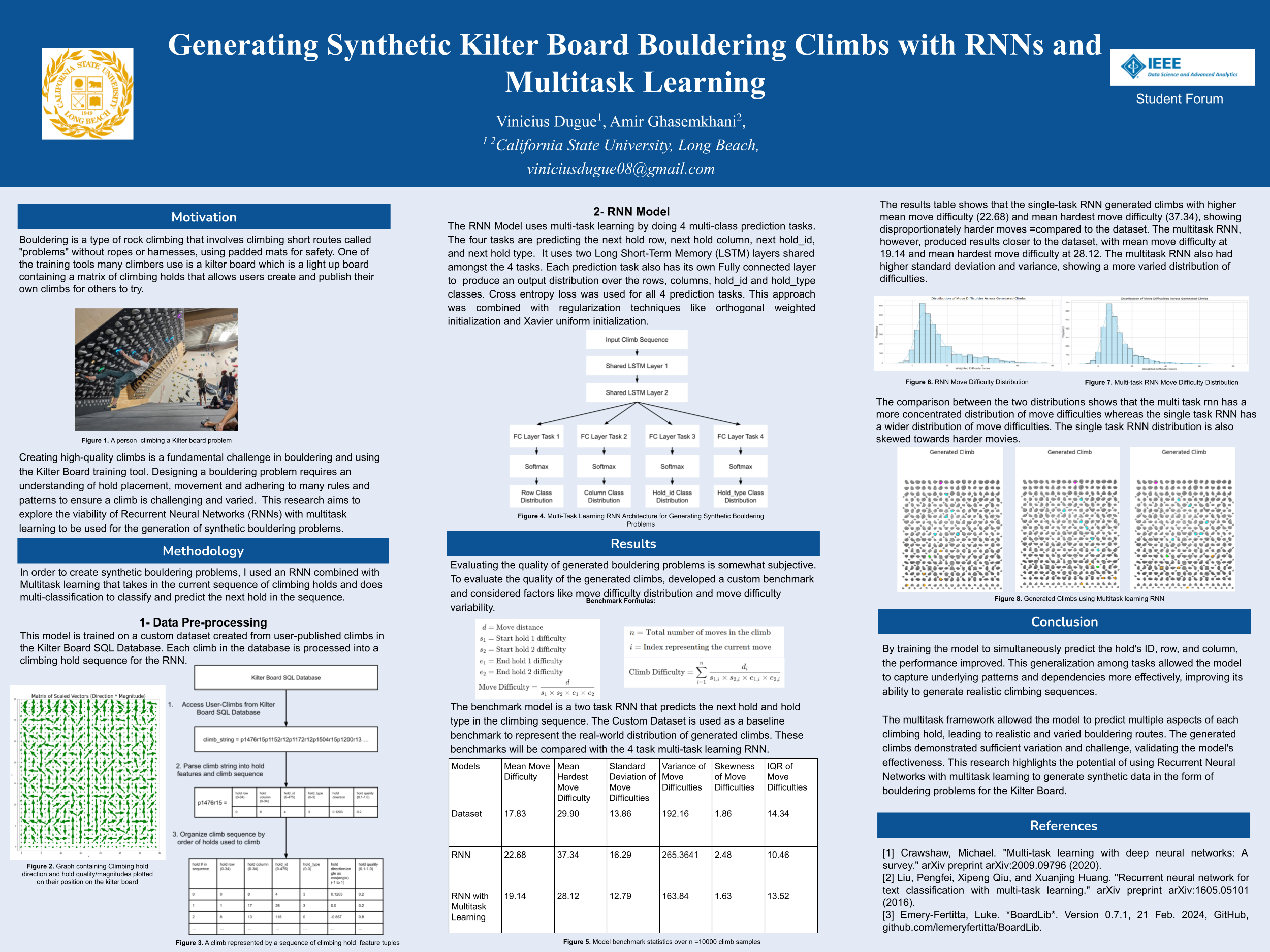
In October 2024 I got to present the project as a poster at the 2024 IEEE DSAA Conference in San Diego. After that I wanted the model to actually be usable for other climbers, not just sitting in a notebook, so I built a full-stack web app so anyone can generate climbs and save them to their library.
Generated climbs
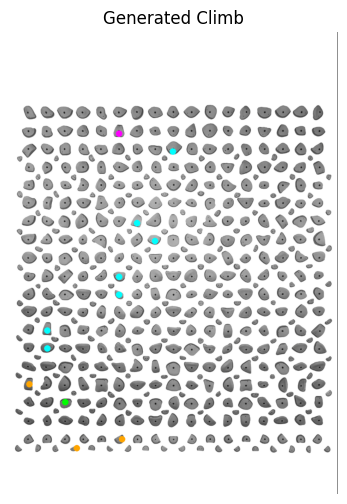
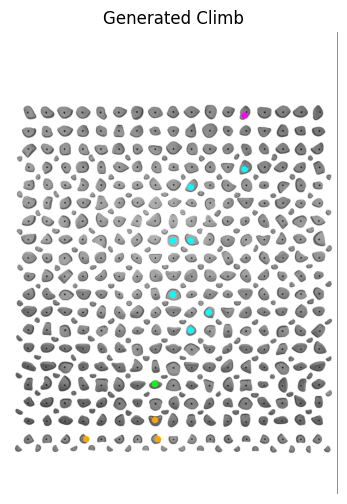
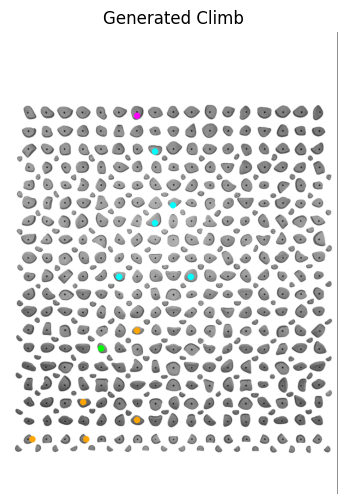
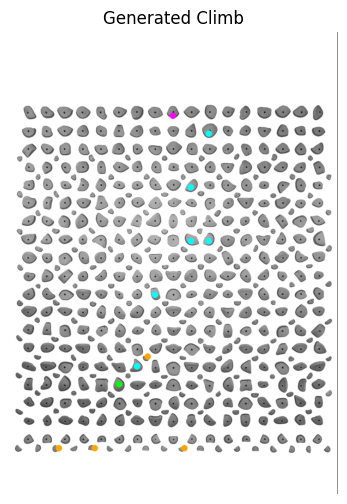
Four routes the model produced. Cyan = handholds, magenta = top, orange = start, green = feet, matching the Kilter Board's own color convention.
Conference poster